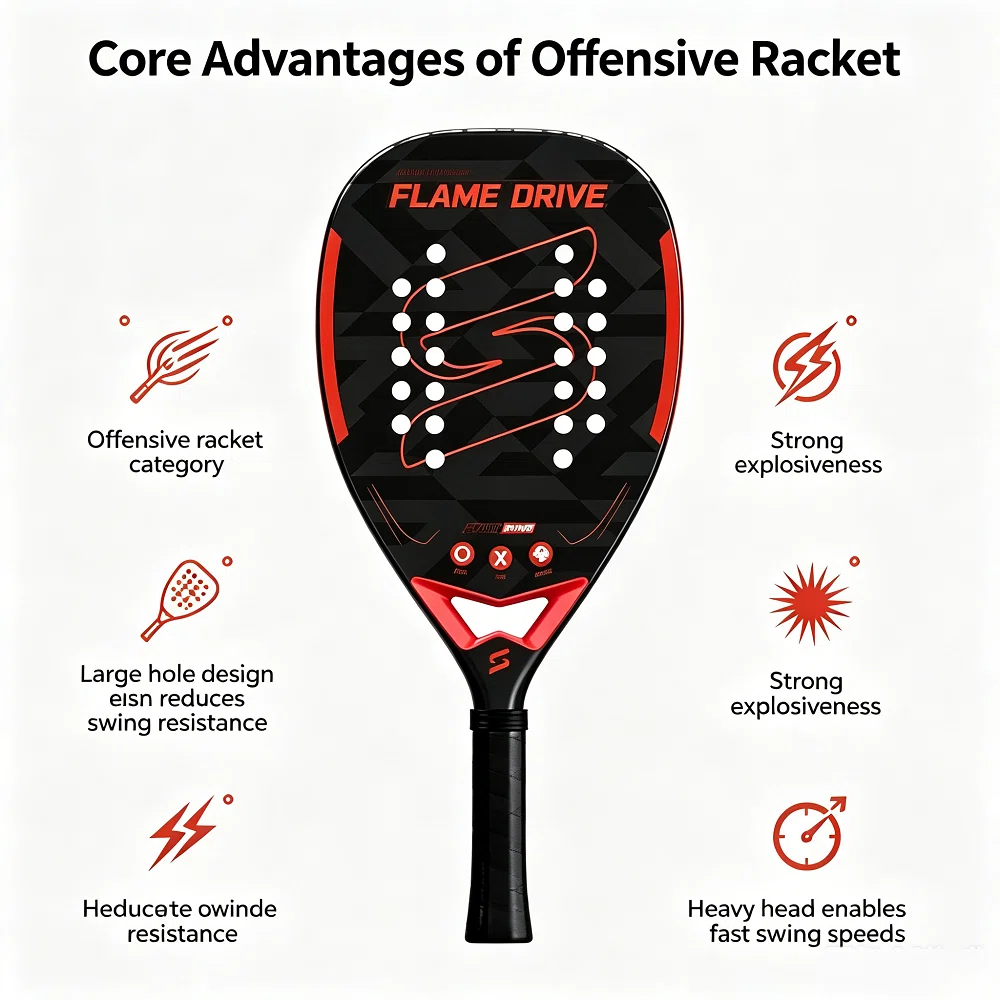
Beach Tennis Racket Design Guide: How Shape, Weight and Balance Affect Performance
Beach tennis has developed into an increasingly recognized racket sport across Europe, South America, North America, and other international markets. As participation grows, demand for specialized beach tennis equipment is also creating opportunities for sports brands, distributors, wholesalers, and private label businesses. For companies planning to enter this market or expand an existing product portfolio, selecting the right beach tennis racket design is an important part of product development.
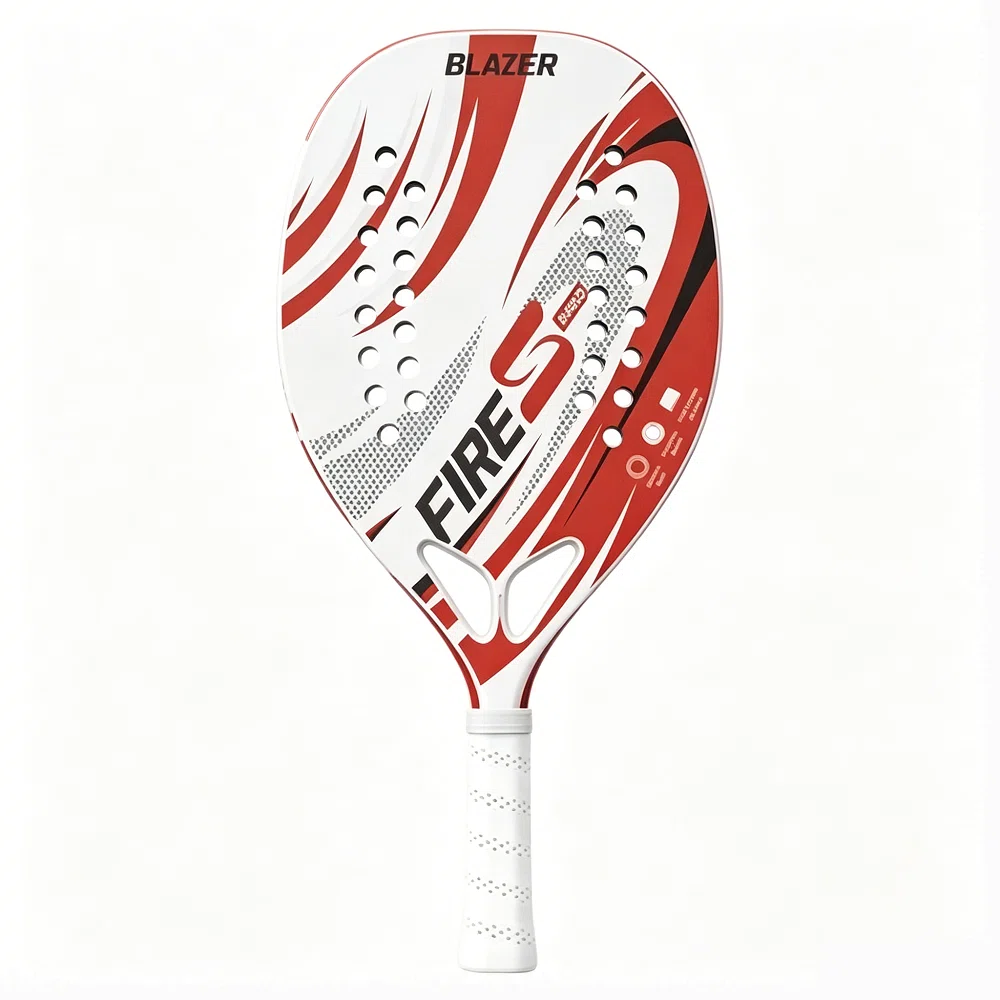
Unlike traditional tennis rackets, beach tennis rackets generally feature a solid hitting surface with strategically arranged holes rather than strings. This construction creates different requirements for racket weight, balance, surface materials, structural strength, and aerodynamic characteristics. Each design decision can influence how the racket feels during play, how easily players control it, and how consistently it performs under different playing conditions.
For B2B buyers, understanding these design factors is important before selecting a manufacturing partner or placing an OEM order. A racket that looks attractive in a product catalog may not necessarily provide the performance characteristics expected by the target customer. Similarly, selecting an expensive carbon fiber material does not automatically guarantee a better product. Overall performance depends on how the racket shape, material combination, thickness, weight distribution, surface construction, and manufacturing process work together.
This guide explains the major considerations involved in beach tennis racket design. It covers racket shapes, weight ranges, balance characteristics, carbon fiber materials, structural construction, customization opportunities, and quality control. It is intended to help sports equipment brands, product engineers, importers, and wholesale buyers make more informed decisions when developing or sourcing custom beach tennis rackets.
1. Understanding the Basic Design of a Beach Tennis Racket
A beach tennis racket is specifically designed for a sport played on sand, generally using a lightweight ball and a net. Because the ball is not intended to bounce off the playing surface during normal rallies, players need to control the ball through direct contact with the racket. This makes racket handling, hitting consistency, and maneuverability important considerations in product development.
The main structural components of a beach tennis racket typically include the racket head, hitting surface, frame, internal core or structural filling, throat or connecting section, and handle. These components must work together to create a racket with suitable stiffness, strength, weight, and playing characteristics.
The racket head provides the main contact area for the ball. Its overall shape, dimensions, thickness, and hole distribution influence the available hitting area and the way the racket moves through the air. The hitting surface is commonly manufactured using composite materials such as fiberglass or carbon fiber. The internal construction supports the surface and helps determine the overall structural response.
The handle is another important component because it connects the racket to the player's hand. Handle length, grip circumference, surface texture, and overall construction influence comfort and control. For commercial product development, these details should be considered alongside racket head design rather than treated as secondary features.
For manufacturers and OEM buyers, the challenge is to balance these components according to the intended market position. A recreational racket may prioritize comfort, accessibility, and durability, while a premium performance racket may focus on material specifications, structural consistency, and more specialized handling characteristics.
2. Beach Tennis Racket Shape and Its Influence on Performance
Racket shape is one of the most visible design characteristics and an important starting point for custom beach tennis racket development. Different head geometries can change the available hitting area, the distribution of material, the overall appearance, and the location of the racket's center of mass.
Although manufacturers and brands may use different naming conventions, round, teardrop, and diamond-inspired profiles are useful design references when discussing beach tennis racket geometry. These shapes should be evaluated according to their actual dimensions and construction rather than relying only on marketing names.
2.1 Round Shape Beach Tennis Rackets
Round-shaped beach tennis rackets generally feature a relatively symmetrical head profile. The wider central section provides a broad hitting area, while the gradual transition toward the handle creates a balanced overall appearance.
For recreational and developing players, a round shape can be an attractive design option because it allows brands to develop products around accessibility, comfortable handling, and general-purpose use. However, the actual playing characteristics depend on the racket's weight, balance, thickness, stiffness, and surface construction.
From an engineering perspective, a round racket head can provide a relatively straightforward geometry for controlling the distribution of material around the hitting area. Designers can adjust the width, length, edge profile, and hole pattern to achieve different structural and visual results.
Round-shaped designs may also be suitable for brands looking to create a consistent product family with several material options. For example, a manufacturer may develop a fiberglass version for entry-level buyers and a carbon fiber version for a more premium market while maintaining a similar external profile.
When developing a round-shaped beach tennis racket, buyers should evaluate the actual hitting area, perimeter thickness, total weight, and balance point. A wider head does not automatically produce better control, and the complete racket geometry must be assessed through prototype testing.
2.2 Teardrop Shape Beach Tennis Rackets
Teardrop-shaped beach tennis rackets feature a head profile that is generally wider toward the upper or central hitting region and narrower toward the lower section. This design creates a distinctive appearance and offers manufacturers flexibility when adjusting the relationship between the hitting area and the overall racket structure.
For brands developing a versatile product range, teardrop geometry can provide a useful middle ground between different head profiles. The design can be modified through changes in head width, shoulder curvature, length, and thickness distribution.
From a product engineering perspective, the position of the widest section is particularly important. Moving this area upward or downward can influence the mass distribution of the racket head. The resulting balance should be measured on completed prototypes because the final result also depends on the frame, core, surface layers, handle, and grip.
Teardrop shapes are also suitable for visual differentiation. Brands can combine the geometry with different carbon fiber surface patterns, printed graphics, color combinations, and edge treatments to create a recognizable product identity.
For OEM projects, the teardrop profile should be defined through technical drawings rather than relying only on a reference photograph. Important dimensions include overall length, maximum head width, width at specified positions, throat geometry, and total thickness.
2.3 Diamond Shape Beach Tennis Rackets
Diamond-inspired beach tennis racket designs typically feature a more angular or tapered head profile. The upper region may be narrower or differently shaped compared with round and teardrop designs, depending on the manufacturer's specific geometry.
This design direction is often used for performance-oriented product concepts. It provides opportunities to modify the location of the head mass, the dimensions of the hitting area, and the structural layout around the upper section.
However, it is important for buyers to understand that a diamond-shaped racket is not automatically more powerful or more advanced. The actual performance depends on the complete construction, including the racket's weight, balance, stiffness, surface material, and internal structure.
For engineering teams, diamond-inspired geometry may require additional attention to the transition areas between the frame and hitting surface. These regions should be evaluated for structural consistency, manufacturing repeatability, and resistance to damage during normal use.
For brands targeting experienced players, this shape can provide another product option within a differentiated product portfolio. The final specification should be established through prototype evaluation and feedback from players in the intended market.
2.4 Comparing Different Racket Shapes
When comparing round, teardrop, and diamond-inspired beach tennis racket designs, buyers should avoid making decisions based only on appearance. Each design should be assessed using measurable dimensions and completed racket performance.
Important comparison factors include maximum head width, total racket length, hitting area, thickness, weight distribution, frame construction, and the position of the balance point.
Brands may also consider how each design fits into their existing product portfolio. A round racket may serve as an accessible entry-level option, while teardrop and diamond-inspired designs may support additional product differentiation. These are possible merchandising strategies rather than fixed performance classifications.
For OEM manufacturing, the most useful approach is to define the target player group and product positioning first. The manufacturer can then recommend suitable geometry, materials, and structural specifications for prototype development.
3. Beach Tennis Racket Weight and Its Importance
Weight is one of the most important specifications in beach tennis racket development. It directly affects how the racket feels in the player's hand and how much effort is required to accelerate, reposition, and control it during play.
For commercial buyers, weight should not be selected simply because a lighter racket sounds more attractive. The ideal specification depends on the target customer, racket construction, intended product category, and the balance between maneuverability and structural requirements.
3.1 Lightweight Beach Tennis Rackets
Lightweight beach tennis rackets are often developed for players who value easy handling and quick racket movement. A lighter overall structure can make repeated movements feel less demanding, particularly during fast exchanges where players need to reposition the racket quickly.
For brands targeting recreational players, younger users, or customers who prefer a more maneuverable product, lightweight construction can be an important product feature.
However, reducing weight requires careful engineering. Simply removing material may reduce structural strength or change the racket's stiffness. Manufacturers must consider the thickness of the composite layers, frame geometry, internal support, and bonding quality when developing a lightweight design.
Material selection also plays a major role. Carbon fiber composites may offer useful strength-to-weight characteristics, while fiberglass can provide a different combination of flexibility, cost, and manufacturing requirements.
For OEM buyers, lightweight specifications should always be verified using complete production-style samples. The total weight must include the handle, grip, edge protection, surface layers, and other finished components.
3.2 Medium-Weight Beach Tennis Rackets
Medium-weight rackets can be considered for product lines intended to provide a balance between handling and overall racket stability. They offer brands an opportunity to develop versatile products for a broader customer group.
In practice, the meaning of lightweight, medium-weight, and heavyweight depends on the product range and the specifications selected by each manufacturer. There is no single weight classification that should be applied to every beach tennis racket without considering its construction and intended use.
For product development, it is more useful to establish an exact target weight and acceptable production tolerance. For example, an OEM specification may define a target weight of 330 grams with an agreed tolerance, provided that the value is appropriate for the intended design.
The manufacturer should also document whether the stated weight includes the standard grip and any additional protective components. Without a consistent measurement method, comparisons between different samples or suppliers may be misleading.
3.3 Heavier Beach Tennis Rackets
Heavier beach tennis rackets may appeal to players who prefer a more substantial feeling during racket movement. Depending on the design, additional mass can influence the perceived stability of the racket and the effort required to accelerate it.
However, greater weight also increases the physical demand associated with moving and repositioning the racket. The result depends on where the additional mass is located rather than only the total weight.
For example, two rackets with identical total weights may feel very different if one has more mass concentrated toward the head while the other distributes more mass toward the handle.
For manufacturers, this means that weight optimization should be considered together with balance point and swing characteristics. Changing the frame thickness, composite layup, core structure, or handle construction can alter the final result.
3.4 Weight Consistency in Mass Production
For B2B procurement, weight consistency is as important as the target specification. A product range with noticeable differences between individual rackets may create customer complaints and make quality control more difficult.
Manufacturers should establish a defined weighing procedure for finished products. The procedure should specify the measurement equipment, product condition, grip configuration, and acceptable tolerance.
For larger OEM orders, buyers can request pre-production samples and production inspection records to confirm that the approved specification can be maintained during manufacturing.
Weight control should also be connected with dimensional inspection. A racket that meets the weight target but has inconsistent thickness, geometry, or structural bonding may still fail to meet the buyer's quality requirements.
4. Beach Tennis Racket Balance: Head-Heavy, Even Balance and Head-Light
Balance describes how the mass of a racket is distributed along its length. It is usually evaluated by measuring the distance between the handle end and the racket's balance point.
For beach tennis racket design, balance is an important specification because it influences the way the racket feels when held and moved. Two rackets with the same total weight may have different handling characteristics because their mass distributions are different.
4.1 Head-Heavy Balance
A head-heavy racket has its balance point positioned relatively farther toward the racket head. This configuration places a greater proportion of the racket's mass away from the hand.
Depending on the overall construction, players may perceive this design as having a more substantial head feel. It can also influence rotational resistance during racket movement.
For product engineers, head-heavy designs require careful evaluation of the relationship between head geometry, frame thickness, material distribution, and total weight.
Brands should avoid assuming that increasing head weight automatically improves performance. A racket that becomes difficult to reposition may not match the needs of customers who prioritize fast handling.
4.2 Even Balance
An even-balanced racket is designed with a more moderate distribution of mass between the head and handle. This configuration can be used when a brand wants to develop a general-purpose product without emphasizing an extreme head-heavy or head-light feeling.
Even balance is a useful starting point for some OEM development projects because it allows engineers to explore different weight and material combinations while maintaining a relatively neutral design objective.
However, the term even balance should not be interpreted as meaning that the racket has equal mass in its head and handle. The balance point is a measurable distance, not a direct description of equal component weights.
4.3 Head-Light Balance
A head-light racket has its balance point positioned closer to the handle. This configuration generally reduces the amount of mass concentrated toward the head.
Some players may prefer this feeling because it can make the racket easier to reposition during rapid movements. Nevertheless, the final handling experience depends on total weight, swing characteristics, grip dimensions, and the complete structural design.
For brands targeting customers who prefer maneuverability, head-light construction may be worth evaluating during product development.
4.4 Measuring and Controlling the Balance Point
Balance should be measured on finished rackets rather than estimated from component specifications. A practical measurement process places the racket on a suitable balance fixture and identifies the point at which it remains in equilibrium.
The distance from the handle end to this point can then be recorded in millimeters. This provides a repeatable specification for prototype comparison and production inspection.
For OEM projects, the balance specification should identify the measurement reference point, grip configuration, and acceptable tolerance. These details help prevent misunderstandings between the buyer and manufacturer.
When adjusting balance, engineers can evaluate different approaches, including changes to the head geometry, composite layer distribution, frame construction, internal materials, and handle design.
5. Understanding Swing Weight and Its Relationship with Racket Balance
Although total weight and balance point are important, they do not fully describe how a beach tennis racket feels during movement. Swing weight is another useful engineering concept when evaluating racket handling.
Swing weight describes the racket's resistance to rotational acceleration around a selected axis, commonly associated with the player's hand or a standardized measurement fixture. It depends on both the total mass and how that mass is distributed along the racket.
Two rackets can have the same weight and balance point but still show different swing characteristics because their mass distributions are not identical.
For product engineers, this distinction is important when comparing different frame constructions or head geometries. A design with more material toward the outer head region may behave differently from one with a more centralized mass distribution.
When developing premium beach tennis rackets, brands may benefit from measuring swing characteristics alongside weight and balance. This creates a more complete technical profile for each product model.
Manufacturers should also distinguish between measured engineering values and subjective player feedback. Both are useful, but they serve different purposes. Engineering measurements help establish repeatable specifications, while player testing helps determine whether the resulting product meets the intended market requirements.
6. Carbon Fiber Materials for Beach Tennis Racket Manufacturing
Material selection has a significant influence on the performance, appearance, cost, and manufacturing requirements of a beach tennis racket. Among the available composite materials, carbon fiber and fiberglass are widely considered in racket development.
For OEM and ODM buyers, the decision should be based on the target market, desired product positioning, structural requirements, budget, and production capabilities.
6.1 Carbon Fiber Beach Tennis Rackets
Carbon fiber is commonly used in premium racket manufacturing because of its favorable strength-to-weight characteristics and ability to provide different stiffness properties through composite design.
Carbon fiber fabrics and laminates can be arranged in different orientations to influence the mechanical behavior of the racket. The selected fiber type, fabric construction, resin system, layer count, and manufacturing process all contribute to the final structural characteristics.
For brands developing premium products, carbon fiber can also provide a distinctive technical appearance. Different surface patterns and finishes can help create a recognizable visual identity across a product family.
However, carbon fiber should not be evaluated only by the material grade printed in a product description. The actual construction, fiber orientation, resin content, laminate thickness, and manufacturing quality are equally important.
For example, a product described as T700 carbon fiber should have a clearly defined material specification and traceable manufacturing documentation where such verification is required. Buyers should request confirmation of the actual material used rather than relying entirely on marketing terminology.
6.2 T300, T500, T700 and T800 Carbon Fiber
Different carbon fiber grades may be considered when developing beach tennis rackets for different market segments. T300, T500, T700, and T800 are commonly used grade designations in carbon fiber discussions, although the actual mechanical properties must be confirmed from the relevant manufacturer's technical data.
T300 carbon fiber can be considered for product concepts where a cost-conscious composite solution is required. Its suitability depends on the laminate design and the mechanical requirements of the finished racket.
T500 and T700 carbon fiber may be selected for different performance-oriented product development projects. However, buyers should not assume that a higher grade number automatically means a better finished racket.
T800 carbon fiber is another option for specialized premium product concepts. Its use should be evaluated according to the required mechanical properties, composite design, manufacturing process, and overall product cost.
For procurement teams, the most important step is to define the actual material specification. The purchase specification should include the required fiber type, fabric construction, layer arrangement where applicable, and any relevant mechanical or quality requirements.
6.3 Fiberglass Beach Tennis Rackets
Fiberglass is another important composite material for racket manufacturing. Compared with carbon fiber, fiberglass can offer different flexibility, cost, and processing characteristics.
For entry-level and mid-range beach tennis rackets, fiberglass may provide an attractive material solution depending on the desired product characteristics.
Its use can also help brands develop a more accessible price segment without abandoning composite construction. This is particularly relevant for distributors and private label companies that want to offer several product levels within one collection.
However, fiberglass construction must still be engineered correctly. The number of layers, resin system, fabric orientation, thickness, and bonding process influence the quality and behavior of the finished product.
6.4 Carbon Fiber and Fiberglass Material Comparison
Carbon fiber and fiberglass should be compared according to the complete product requirements rather than one isolated property.
Carbon fiber may be selected for premium positioning, specific stiffness requirements, and lightweight structural concepts. Fiberglass may be suitable for products where material cost, flexibility, and accessible pricing are more important.
For brands building a product portfolio, using different composite materials can support multiple price levels. A manufacturer can help evaluate the appropriate material combination through sample development and controlled testing.
It is also possible to investigate hybrid composite structures that combine different reinforcement materials. These designs require careful consideration of bonding compatibility, layer arrangement, thickness, and manufacturing repeatability.
7. Racket Thickness, Structural Stiffness and Internal Construction
Racket thickness is another important factor in beach tennis racket design. It affects the available internal space, structural geometry, material requirements, and overall product dimensions.
Different racket thicknesses can be considered for different product concepts. However, increasing thickness does not automatically improve performance. The final result depends on the interaction between the outer composite layers, internal structure, frame, and bonding system.
Structural stiffness is also influenced by material properties and construction. A racket that is too flexible for its intended use may not provide the desired consistency, while an excessively stiff design may not deliver the preferred feel for every player.
For product engineers, stiffness should be evaluated through suitable testing and prototype comparison. Manufacturers can investigate different composite layups, reinforcement arrangements, and structural configurations to achieve the intended design objective.
Internal construction should also be consistent across production batches. Variations in resin distribution, bonding, layer placement, or curing conditions can influence the finished racket's weight and structural characteristics.
For B2B customers, it is useful to request a description of the manufacturing process and relevant quality inspection procedures before approving a large production order.
8. Hole Patterns and Aerodynamic Design
Beach tennis rackets commonly feature holes distributed across the hitting surface. These holes are an important design characteristic and contribute to the distinctive appearance of the product.
The number, diameter, arrangement, and spacing of the holes can be adjusted during product development. These design parameters may influence the distribution of material, local structural characteristics, and the way air moves around the racket during movement.
Hole placement should not be treated as a purely decorative decision. The pattern needs to be compatible with the racket's geometry and structural requirements.
For example, designers should consider the distance between holes, the remaining material around each opening, and the relationship between the hole pattern and the composite reinforcement layers.
Hole patterns should also be evaluated for manufacturing consistency. Irregular openings, poor edge finishing, or inconsistent placement may affect product appearance and quality.
For custom beach tennis racket development, buyers can provide a reference pattern or request a manufacturer to develop a new layout. The final design should be checked against the approved drawing and prototype.
9. Handle Design, Grip Comfort and Ergonomics
The handle is an important part of the complete racket system because it determines how the player holds and controls the equipment. Even when two rackets have similar head geometry and total weight, different handle dimensions can create different handling experiences.
Important handle specifications include handle length, circumference, shape, surface texture, material, and grip construction.
Handle length should be selected according to the overall racket design and intended user group. A longer handle may provide a different gripping arrangement, while a shorter design can support a more compact product configuration.
Grip circumference also requires attention. A handle that is too large or too small may not suit the intended customer group. For brands selling into different markets, offering several grip configurations may be worth considering.
Grip materials should be evaluated for comfort, moisture management, wear resistance, and durability. The grip should remain secure during normal playing conditions and should be compatible with the handle construction.
From a manufacturing perspective, handle dimensions should be defined in technical drawings. This makes it easier to maintain consistency between samples and production units.
10. Surface Finish, Printing and Product Appearance
Product appearance is an important factor in the competitive sports equipment market. For private label brands, the visual design of a beach tennis racket can influence product recognition and help distinguish one collection from another.
Common customization options include printed logos, color combinations, graphic patterns, surface finishes, decorative textures, and personalized packaging.
Carbon fiber surfaces can provide a technical appearance, while fiberglass constructions can support a wide range of printed graphic concepts. The actual appearance depends on the material, coating, printing technology, and finishing process.
For OEM projects, artwork should be prepared according to the manufacturer's requirements. Important details include logo dimensions, print position, color references, artwork format, and any special finishing requirements.
Brands should also request physical samples when color accuracy is important. Digital artwork and screen previews cannot always represent the exact appearance of the finished product.
Surface durability is another important consideration. The selected printing and finishing system should be evaluated for adhesion, abrasion resistance, and compatibility with the underlying composite surface.
For premium product lines, brands may consider a combination of carbon fiber visual patterns, custom graphics, and distinctive edge finishing. The final appearance should remain consistent with the intended market positioning.
11. How to Develop a Beach Tennis Racket for Different Market Segments
One of the most important decisions for sports equipment brands is identifying the correct customer segment before developing a new racket. Different markets may have different expectations regarding price, appearance, materials, handling, and product durability.
11.1 Entry-Level Beach Tennis Rackets
Entry-level products are generally designed for customers who are new to the sport or who want an accessible recreational racket. For this market segment, brands may prioritize practical construction, comfortable handling, attractive appearance, and competitive pricing.
Fiberglass composite construction can be considered for suitable entry-level product concepts. However, the final specification should still meet defined requirements for structural quality, weight consistency, and durability.
For wholesalers, an entry-level product can provide an opportunity to reach a wider customer group and establish a foundation for additional product categories.
11.2 Mid-Range Beach Tennis Rackets
Mid-range products can target regular recreational players who want more specialized equipment without moving directly into the highest price category.
Depending on the intended positioning, brands may consider upgraded fiberglass construction, selected carbon fiber reinforcement, improved surface finishing, and more detailed weight and balance specifications.
For this segment, product differentiation should be based on measurable construction features and a clear value proposition rather than unsupported performance claims.
11.3 Premium Beach Tennis Rackets
Premium products generally require more detailed material selection and structural development. Carbon fiber composites, carefully controlled laminate construction, refined surface finishing, and tighter production specifications may be considered.
For brands targeting experienced players, the development process should include prototype testing, feedback collection, and comparison of different material and balance configurations.
Premium positioning also requires reliable production quality. Buyers should pay attention to material traceability, weight consistency, bonding quality, dimensional accuracy, and finished product inspection.
12. OEM Beach Tennis Racket Manufacturing: From Concept to Production
OEM manufacturing allows sports equipment brands to develop products under their own names using a manufacturing partner's production capabilities. For companies entering the beach tennis market, this approach can reduce the need to establish their own production facilities.
A successful OEM project requires more than selecting an existing product and adding a logo. The buyer and manufacturer need to agree on the product specification, materials, geometry, surface design, quality requirements, and packaging.
12.1 Product Concept and Market Positioning
The first step is defining the target market and product category. Buyers should identify whether the new racket is intended for entry-level, recreational, mid-range, or premium customers.
This decision influences material selection, target weight, design complexity, appearance, and expected manufacturing cost.
Brands should also consider the relationship between the new racket and their existing product portfolio. A new model should offer a clear reason for customers to choose it rather than simply duplicating another product.
12.2 Technical Drawings and Specification Development
After the concept has been established, the next step is translating the product requirements into technical specifications.
These may include overall racket length, head width, maximum thickness, handle length, grip circumference, target weight, balance point, hole pattern, surface material, and edge construction.
Technical drawings help reduce misunderstandings and provide a common reference for design review, sample approval, and production inspection.
For custom products, buyers should identify which dimensions are critical and which features can be adjusted during prototype development.
12.3 Material Selection and Prototype Development
The manufacturer can then evaluate the proposed materials and construction methods. Carbon fiber, fiberglass, composite layers, resin systems, and internal structural materials should be selected according to the intended product requirements.
Prototype development allows the buyer to assess the actual racket rather than relying entirely on drawings or digital images.
During this stage, brands should review the shape, dimensions, weight, balance, surface appearance, handle comfort, and overall construction quality.
Where necessary, the manufacturer can produce revised samples with adjustments to material combinations, geometry, or weight distribution.
12.4 Sample Testing and Approval
Before moving into mass production, the approved sample should be evaluated under the intended usage conditions.
Testing may include dimensional inspection, weight measurement, balance measurement, surface quality evaluation, bonding inspection, and practical playing tests.
For products intended for premium markets, buyers may also establish additional internal testing requirements based on their quality standards.
All important changes should be documented so that the final production specification matches the approved sample.
12.5 Mass Production and Quality Control
After sample approval, the manufacturer can prepare the production process according to the agreed specifications.
Quality control should cover incoming materials, composite preparation, molding or forming operations, bonding, finishing, printing, assembly, and final inspection.
For larger orders, buyers may define acceptable tolerances for weight, dimensions, appearance, and other critical characteristics.
Production inspection should focus on both individual product quality and consistency across the complete order. This is particularly important for brands that plan to reorder the same model over an extended period.
13. ODM Beach Tennis Racket Development for Private Label Brands
ODM manufacturing provides another development option for companies that want to launch beach tennis rackets without creating every design element from the beginning.
Under an ODM arrangement, a manufacturer may provide existing design concepts, product structures, material combinations, or development solutions that can be adapted to the buyer's requirements.
This approach can help new sports brands enter the market more efficiently. It may also be useful for distributors who want to expand their existing product selection with customized equipment.
Customization opportunities may include racket color, printed logo, graphic design, grip material, packaging, and selected product specifications. Depending on the manufacturing arrangement, some structural and dimensional modifications may also be possible.
For buyers, it is important to distinguish between standard customization and complete structural development. Changes to materials, molds, dimensions, or internal construction may require additional engineering work, tooling, sample development, and cost evaluation.
Brands should also clarify ownership and permitted use of custom artwork, technical drawings, molds, and product designs. These matters should be agreed upon before production begins.
14. Important Quality Control Standards for Beach Tennis Rackets
Product quality is a critical consideration for distributors, importers, and private label brands. A visually attractive sample does not guarantee that every unit in a mass production order will meet the same requirements.
For this reason, quality control should be integrated into the manufacturing process rather than limited to final inspection.
14.1 Dimensional Accuracy
Dimensional inspection should verify the racket's overall length, maximum width, thickness, handle dimensions, and other agreed critical measurements.
Inspection results should be compared with the approved technical drawing. Where specific dimensions are important for product performance or compatibility, buyers should define clear tolerance requirements.
14.2 Weight and Balance Consistency
Weight and balance should be checked using consistent measurement procedures. Manufacturers should identify the acceptable production range and document the measurement method.
For product families with different material options, each model should have its own approved specification rather than sharing a general weight target.
14.3 Composite Surface and Bonding Quality
Composite surfaces should be inspected for visible defects, uneven finishing, bubbles, delamination, and other issues that may affect appearance or structural integrity.
Bonding quality is particularly important because the racket relies on the combination of multiple materials and structural components.
Manufacturers should establish suitable process controls to reduce variations during material preparation, molding, bonding, and finishing.
14.4 Handle and Grip Inspection
The handle should be checked for dimensional consistency, secure attachment, surface defects, and overall finishing quality.
Grip installation should also be reviewed to ensure that the finished product meets the approved specification.
14.5 Packaging and Export Preparation
Packaging should protect the racket during handling, storage, and international transportation.
Depending on the buyer's requirements, packaging options may include individual protective bags, printed boxes, cartons, product labels, and customized retail packaging.
For international shipments, the packaging design should consider the destination market, shipping method, carton strength, and product presentation requirements.
15. How to Choose a Reliable Beach Tennis Racket Manufacturer in China
China is an important sourcing destination for sports equipment brands seeking OEM and ODM manufacturing solutions. However, not all suppliers have the same technical capabilities, material sourcing systems, or quality control procedures.
For international buyers, selecting the right manufacturing partner requires evaluating several factors beyond the initial quotation.
15.1 Composite Material Knowledge
A qualified supplier should understand the differences between carbon fiber and fiberglass construction and be able to explain the available material options.
Buyers should ask about material specifications, composite construction, available surface finishes, and how the selected materials influence product cost and manufacturing requirements.
15.2 Customization and Product Development Capabilities
Brands developing their own product collections should evaluate whether the supplier can support custom racket shapes, dimensions, colors, logos, materials, and packaging.
For more advanced projects, the buyer should also understand whether the manufacturer can support prototype modifications and technical specification development.
15.3 Sample Quality and Production Consistency
Sample quality is an important indication of a supplier's ability to understand and execute product requirements.
However, buyers should also evaluate how the supplier maintains consistency during mass production. Relevant questions include how materials are inspected, how weight is controlled, how defects are identified, and how finished products are checked before shipment.
15.4 Communication and Technical Support
International OEM projects often involve multiple rounds of technical communication. Clear responses regarding drawings, materials, tolerances, samples, and production schedules can help reduce project delays.
For overseas buyers, communication should be supported by clear written specifications and documented sample approvals.
15.5 Pricing and Total Procurement Cost
Product pricing should be evaluated together with material specifications, order quantity, customization requirements, packaging, tooling, and shipping arrangements.
A low quotation may not represent the best value if the supplier uses different materials or cannot maintain the required quality standards.
Buyers should request quotations based on the same technical specification when comparing different suppliers.
16. Custom Beach Tennis Racket Solutions for Different Brand Requirements
Every sports brand has different commercial objectives. Some companies want to launch a complete beach tennis product range, while others need one specialized model to complement their existing tennis, padel, or pickleball collections.
A flexible OEM and ODM development approach allows brands to select product characteristics according to their own market strategy.
16.1 Custom Racket Shape and Dimensions
Brands can explore different head profiles, racket lengths, widths, thicknesses, and hole arrangements. These design parameters should be defined through drawings and reviewed during sample development.
Custom dimensions can help establish product differentiation and provide opportunities to develop models for different player preferences.
16.2 Custom Carbon Fiber and Fiberglass Materials
Depending on the intended product category, buyers can evaluate different carbon fiber grades, fiberglass construction, and composite combinations.
Material selection should be based on verified specifications, structural requirements, manufacturing feasibility, and target pricing.
16.3 Custom Weight and Balance
Weight and balance can be included as key design parameters in an OEM project. Buyers should provide target values and acceptable tolerances wherever possible.
Manufacturers can then evaluate different material distributions and structural configurations to develop a racket that matches the intended product concept.
16.4 Custom Logo, Color and Packaging
Private label customization may include brand logos, printed graphics, surface colors, grip designs, product labels, and retail packaging.
For companies building a recognizable sports equipment brand, consistent visual identity across the complete product range is an important commercial consideration.
17. Product Development Mistakes Beach Tennis Racket Buyers Should Avoid
Developing a competitive beach tennis racket requires a clear understanding of both technical specifications and customer expectations. Several common mistakes can increase development costs or create problems during production.
17.1 Choosing a Racket Only by Appearance
A visually attractive racket may help generate initial customer interest, but appearance alone cannot determine product suitability.
Buyers should evaluate the actual weight, balance, dimensions, surface construction, and structural quality before approving a model.
17.2 Assuming Higher Carbon Fiber Grades Always Mean Better Quality
Carbon fiber grade is only one part of the complete composite system. The fabric construction, fiber orientation, resin, layer arrangement, and manufacturing process also influence the finished product.
Brands should request clear material specifications and evaluate completed samples rather than relying only on grade names.
17.3 Ignoring Weight Distribution
Two rackets with identical total weights may have very different handling characteristics. Ignoring balance and mass distribution can result in a product that does not meet the intended player preferences.
Weight, balance point, and swing characteristics should be considered together during product development.
17.4 Changing Specifications After Sample Approval
Uncontrolled changes to materials, dimensions, graphics, or construction can create differences between the approved sample and mass-produced goods.
Any important changes should be documented and approved before production continues.
17.5 Focusing Only on Unit Price
Procurement decisions should consider the complete cost structure, including materials, customization, tooling, packaging, quality control, and international logistics.
For long-term cooperation, stable product quality and repeatable manufacturing are often more important than obtaining the lowest initial quotation.
18. Building a Competitive Beach Tennis Racket Product Portfolio
For sports brands and distributors, offering multiple beach tennis racket models can help address different customer requirements and price segments.
A well-planned product portfolio does not necessarily require a large number of completely different designs. Instead, brands can develop a structured collection using selected variations in materials, weight, balance, graphics, and product positioning.
For example, an entry-level product may use a fiberglass-based construction, while a more advanced model may incorporate carbon fiber reinforcement. A premium product can then be developed around a more specialized composite specification and carefully controlled weight distribution.
Brands can also create visual differentiation through round, teardrop, and diamond-inspired head profiles. Each model should have a clear product purpose rather than simply introducing another design without meaningful differentiation.
When developing a new collection, buyers should consider the relationship between product specifications, target retail price, expected order volume, and the capabilities of the manufacturing partner.
For distributors, a balanced portfolio may provide more flexibility when serving different retail channels. For private label brands, it can help establish a consistent product identity while providing customers with several choices.
19. Why Work with Sunny Paddle for Custom Beach Tennis Rackets
Sunny Paddle focuses on the development and supply of sports rackets for international brands, wholesalers, distributors, and OEM/ODM customers. Our product range includes beach tennis rackets, pickleball paddles, and padel rackets, supporting buyers who want to develop or expand their sports equipment collections.
For beach tennis racket projects, Sunny Paddle supports product customization based on customer requirements. Buyers can discuss different racket shapes, dimensions, materials, surface designs, weight targets, branding options, and packaging solutions.
Our beach tennis racket development direction includes carbon fiber and fiberglass product concepts. Depending on the selected model and project requirements, customers can explore different composite specifications and product configurations.
19.1 Custom Carbon Fiber Beach Tennis Rackets
For brands targeting premium product segments, carbon fiber beach tennis rackets provide opportunities to develop specialized product designs and distinctive product appearances.
Customers can discuss carbon fiber material options, racket geometry, surface finishing, graphic design, and other technical requirements during the development process.
Material selection should be confirmed according to the agreed technical specification and the requirements of the finished product.
19.2 Custom Fiberglass Beach Tennis Rackets
For brands targeting more accessible price segments, fiberglass-based racket concepts can provide another option for product development.
Buyers can evaluate different surface graphics, colors, racket shapes, and selected structural configurations according to their target market.
19.3 OEM and ODM Customization Support
Sunny Paddle works with B2B customers who require private label and custom sports racket solutions. Depending on the product and manufacturing requirements, customization can include product appearance, logo printing, materials, specifications, and packaging.
For customers with existing technical drawings, our team can review the proposed specifications and discuss development feasibility. Buyers who are still developing their product concepts can also discuss possible design directions and material options.
Before mass production, sample evaluation and specification confirmation are important steps for ensuring that the product meets the buyer's expectations.
20. Developing Your Next Beach Tennis Racket with an OEM Partner
Successful beach tennis racket development requires coordination between product design, material selection, engineering evaluation, manufacturing, and quality control. A strong product concept must be supported by a technically suitable construction and a repeatable production process.
For international brands, working with an experienced manufacturing partner can make it easier to evaluate different product configurations and develop a collection that fits the intended market.
When planning a new beach tennis racket project, buyers should prepare a clear product brief covering the intended customer group, target price segment, preferred shape, material requirements, target weight, balance characteristics, logo design, and packaging expectations.
If a technical drawing or reference sample is available, it can help the manufacturer understand the project more accurately. If the product is still at the concept stage, the initial discussion can focus on product positioning and possible design directions.
Sunny Paddle welcomes inquiries from sports equipment brands, distributors, wholesalers, and OEM/ODM buyers interested in custom beach tennis rackets. Our team can discuss carbon fiber and fiberglass options, custom product configurations, branding, and packaging according to individual project requirements.
Whether you are launching a new beach tennis racket brand, expanding an existing product range, or sourcing a long-term manufacturing partner in China, selecting the right combination of shape, weight, balance, and materials is an important step toward building a competitive product.
Contact Sunny Paddle to discuss your custom beach tennis racket project and explore OEM and ODM manufacturing solutions for your brand.
Latest blogs