Pickleball Paddle Surface Texture and Spin: What OEM Brands Need to Know About Grit, Coating and Durability
Pickleball paddle surface technology has become an important part of product development for sports equipment brands, distributors, wholesalers, and OEM buyers. As the international pickleball market continues to expand, customers are paying closer attention not only to paddle shape, core construction, and weight, but also to the characteristics of the hitting surface. Surface texture, friction, material selection, coating technology, and long-term durability can all influence how a paddle feels and performs during play.
For brands developing their own pickleball paddle collections, surface design is more than a visual decision. The surface interacts directly with the ball during contact and can influence the consistency of the player's hitting experience. Different materials and finishing methods create different surface characteristics, while manufacturing processes determine how consistently those characteristics can be reproduced across production batches.
Raw carbon fiber surfaces, textured composite surfaces, fiberglass finishes, and other surface treatments are common subjects in paddle development discussions. However, these terms are not interchangeable. A paddle advertised as raw carbon fiber does not automatically have a specific level of surface roughness or spin performance. Likewise, a visibly textured paddle does not necessarily maintain the same surface characteristics after extended use.
For B2B buyers, understanding the relationship between paddle surface texture, ball contact, friction, and durability is essential when selecting a supplier or developing a new product. It is also important to understand the difference between marketing descriptions and measurable manufacturing specifications.
This guide explains the major factors involved in pickleball paddle surface design. It covers raw carbon fiber, surface grit, composite materials, coating technologies, spin-related characteristics, surface wear, quality control, and OEM/ODM customization. The goal is to help sports brands and product engineers make informed decisions when developing reliable pickleball paddles for international markets.
1. Understanding Pickleball Paddle Surface Technology
The hitting surface is the outer layer of a pickleball paddle. It is the part that directly contacts the ball during play and contributes to the overall feel and playing characteristics of the product.
Unlike traditional tennis rackets, pickleball paddles have a solid hitting face rather than a string bed. The surface material and its texture therefore play an important role in the paddle's interaction with the ball.
A typical composite pickleball paddle may contain a surface layer, adhesive or resin system, internal core, edge structure, and handle assembly. Each component contributes to the complete product, but the surface requires special attention because it is exposed to repeated ball contact and normal playing wear.
Common surface materials include carbon fiber composites and fiberglass composites. Other constructions and finishing methods may also be used depending on the product category and manufacturer.
Surface technology can be evaluated from several perspectives:
- Surface material and fiber construction.
- Surface texture and roughness.
- Coating and finishing technology.
- Ball contact and friction characteristics.
- Resistance to abrasion and repeated use.
- Consistency between samples and production batches.
- Compliance with applicable paddle equipment regulations.
For OEM brands, these factors should be considered together. Selecting a surface material without defining the desired finish or quality requirements can create uncertainty during production.
2. What Is Pickleball Paddle Surface Texture?
Pickleball paddle surface texture refers to the physical characteristics of the hitting face. It describes how smooth or rough the surface feels and how its microscopic or visible features are distributed.
Some paddle surfaces appear relatively smooth, while others have visible fiber patterns, embossed structures, coatings, or engineered textures. These differences can influence the interaction between the paddle and the ball.
Surface texture is not determined by appearance alone. Two paddles may look similar in photographs but have different surface characteristics because of differences in material, resin distribution, finishing methods, and production processes.
For product engineers, surface texture should be treated as a manufacturing characteristic that can be evaluated and controlled. Relevant factors may include surface roughness, texture uniformity, coating thickness, exposed fiber structure, and resistance to wear.
For procurement teams, understanding these factors helps avoid vague product descriptions. Instead of simply requesting a high-grit paddle, buyers should specify the intended material, surface finish, quality expectations, and any applicable testing requirements.
2.1 Smooth Pickleball Paddle Surfaces
Smooth paddle surfaces generally have fewer pronounced surface irregularities. Depending on the material and finish, they may have a more uniform appearance and a relatively consistent contact surface.
Some entry-level or recreational paddle designs use surface constructions that prioritize appearance, manufacturing efficiency, and general durability.
A smooth surface does not necessarily mean poor performance. The complete paddle construction and the applicable equipment rules must be considered when evaluating the product.
For OEM development, smooth surfaces can provide a useful starting point for brands that prioritize clean graphics, uniform finishing, and accessible product pricing.
2.2 Textured Pickleball Paddle Surfaces
Textured paddle surfaces contain physical or material features that create a more pronounced surface structure. These features may result from exposed fiber patterns, coatings, molded textures, or other finishing processes.
Textured surfaces are frequently associated with spin-oriented paddle designs because surface friction and ball contact conditions can influence how the ball responds during a stroke.
However, a rougher-looking surface does not automatically produce better spin. The interaction depends on several variables, including paddle motion, ball characteristics, contact conditions, surface material, and the player's technique.
For manufacturers, the main challenge is creating a surface that provides the intended characteristics while remaining consistent, durable, and compliant with relevant equipment regulations.
3. How Pickleball Paddle Surface Texture Influences Spin
Spin is an important playing characteristic in pickleball. Players use different strokes and paddle angles to create topspin, backspin, sidespin, and other ball trajectories.
During ball contact, the paddle surface interacts with the ball through normal and tangential forces. The resulting ball motion depends on the relative movement between the ball and paddle, the contact angle, the speed of the stroke, and the properties of the contacting materials.
Surface friction is one factor that may influence this interaction. However, it is not the only factor determining spin.
For paddle brands, this distinction is important. Marketing claims that focus entirely on surface roughness may oversimplify the physics of ball contact and create unrealistic expectations.
3.1 The Relationship Between Friction and Ball Contact
Friction describes the resistance to relative movement between contacting surfaces. When a player brushes the ball with a paddle during a stroke, tangential interaction at the contact area can contribute to rotational motion.
The surface material, texture, ball condition, and contact dynamics can all influence this process.
A surface with different physical characteristics may produce a different interaction compared with a smooth surface. Nevertheless, the actual result must be evaluated under controlled testing conditions rather than assumed from appearance.
For OEM buyers, this means that surface development should include prototype testing and, where appropriate, measurable evaluation of relevant surface characteristics.
3.2 Surface Texture and Topspin
Topspin is created when the ball rotates forward in the direction of its flight. Players commonly generate topspin by brushing upward across the ball during contact.
The paddle surface can influence the frictional interaction during this movement. However, racket angle, swing path, contact timing, and ball speed remain major contributors.
For manufacturers, developing a paddle intended for spin-oriented players requires attention to the complete product design. The surface should be considered alongside paddle weight, balance, core construction, stiffness, and overall handling characteristics.
3.3 Surface Texture and Backspin
Backspin occurs when the ball rotates in the opposite direction to its forward movement. Players may create this effect through a downward or slicing contact motion.
As with topspin, the paddle surface contributes to the contact interaction but does not independently determine the resulting ball rotation.
Brands developing versatile paddles should therefore avoid describing surface texture as a feature that guarantees a specific spin result. A more accurate approach is to explain the material construction and the intended surface characteristics.
3.4 Surface Consistency and Repeatable Playing Feel
For regular players, consistency is an important part of paddle selection. A surface that varies noticeably across different areas of the hitting face may create an inconsistent product experience.
Manufacturers should aim to maintain uniform surface finishing across the intended hitting area. This includes controlling coating application, composite layer preparation, curing conditions, and final inspection.
For brands purchasing large quantities, consistency between individual paddles is just as important as the characteristics of the approved sample.
4. Raw Carbon Fiber Pickleball Paddle Surfaces
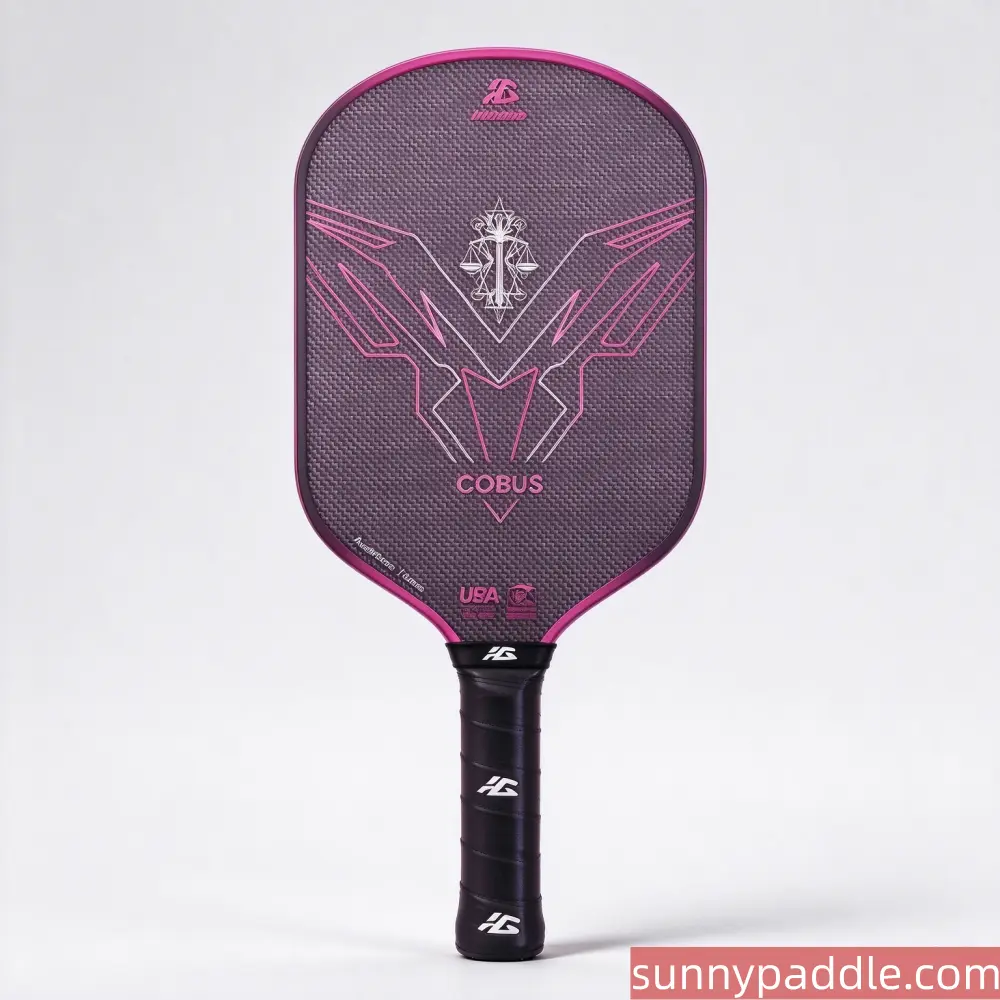
Raw carbon fiber has become an important surface option in the pickleball paddle market. It is commonly associated with premium paddle positioning and technical product development.
In a raw carbon fiber construction, the carbon fiber composite forms the exposed or functional surface rather than relying entirely on a separate decorative coating to create the appearance of the hitting face.
The exact construction can vary between manufacturers. Fiber fabric type, resin system, layer arrangement, surface preparation, and finishing methods all influence the final result.
For brands, raw carbon fiber can provide a distinctive product identity. Its visible fiber pattern can also help communicate a technical manufacturing approach to customers.
4.1 What Makes Raw Carbon Fiber Different?
Raw carbon fiber surfaces are generally developed around the properties of the carbon fiber composite itself. Depending on the design, the surface may display the natural woven or patterned appearance of the reinforcement material.
However, raw carbon fiber does not mean that every product has an identical surface structure. Different fabric patterns, resin systems, processing conditions, and finishing procedures can create different surface characteristics.
For buyers, it is important to request clear information about the actual material construction. The term raw carbon fiber should be supported by a defined material specification rather than used as a general marketing description.
4.2 Raw Carbon Fiber and Surface Friction
The interaction between a carbon fiber surface and a pickleball depends on the complete surface structure. Fiber exposure, resin coverage, texture, and finishing can influence the resulting contact characteristics.
Some raw carbon fiber designs are developed with a textured appearance, but the visible weave pattern alone cannot establish a specific friction value or spin performance.
For OEM product development, buyers can compare different surface samples and evaluate them using agreed testing procedures.
4.3 Raw Carbon Fiber Construction Quality
Carbon fiber surface quality depends on more than the reinforcement material. Resin distribution, layer alignment, bonding, curing, and finishing all influence the final product.
Potential manufacturing defects include visible bubbles, uneven resin distribution, delamination, inconsistent surface appearance, and local defects around the paddle edges.
These issues should be controlled through suitable process management and inspection procedures.
4.4 Raw Carbon Fiber for Premium Paddle Brands
For brands targeting performance-oriented customers, raw carbon fiber may provide a suitable foundation for a premium product line.
It can be combined with different core constructions, paddle thicknesses, edge designs, and surface graphics to create multiple product configurations.
However, premium positioning should be supported by actual material specifications and reliable quality control. The use of carbon fiber alone does not establish the overall quality of a paddle.
5. Carbon Fiber Grades and Surface Material Selection
Carbon fiber grade is frequently mentioned in pickleball paddle product descriptions. Buyers may encounter terms such as T300, T500, T700, and T800 when comparing composite materials.
These designations relate to different carbon fiber material grades, but the finished paddle's performance depends on much more than the grade name.
5.1 T300 Carbon Fiber
T300 carbon fiber is commonly used in composite product development. For pickleball paddle manufacturers, it may be considered when developing products that balance material cost and structural requirements.
The final characteristics depend on the fabric construction, resin system, layer arrangement, and processing method.
For OEM buyers, T300 should be evaluated through a complete material specification rather than treated as a guarantee of a particular paddle performance level.
5.2 T500 Carbon Fiber
T500 carbon fiber may be considered for selected composite applications where the specified material properties match the intended design requirements.
When evaluating a T500 paddle surface, buyers should request information about the reinforcement material and its integration into the complete composite structure.
The grade name alone does not describe the surface roughness, coating thickness, or friction characteristics.
5.3 T700 Carbon Fiber
T700 carbon fiber is another material option used in advanced composite product development. It can be considered for paddle designs that require a particular combination of strength, stiffness, and weight characteristics.
For brands developing premium pickleball products, T700 may form part of a broader material strategy that includes surface construction, core selection, and structural reinforcement.
However, actual material verification remains important. Buyers should confirm that the delivered product uses the agreed material and that the manufacturing specification matches the approved sample.
5.4 T800 Carbon Fiber
T800 carbon fiber may be considered for specialized product development where the material specification is appropriate for the intended application.
For paddle brands, the decision to use T800 should be based on engineering requirements, supplier documentation, product cost, and manufacturing feasibility.
A higher grade designation should not be treated as an automatic indicator of superior playing performance. Composite design and manufacturing quality remain essential.
5.5 Choosing the Right Carbon Fiber Material
When selecting carbon fiber for a pickleball paddle, OEM buyers should consider several factors:
- Actual fiber grade and material documentation.
- Fabric type and weave construction.
- Composite layer thickness and arrangement.
- Resin system and bonding compatibility.
- Target paddle weight and structural stiffness.
- Surface appearance and finishing requirements.
- Manufacturing consistency and total product cost.
The most suitable material is the one that meets the product's technical and commercial requirements. It is not necessarily the material with the highest grade designation.
6. Fiberglass Pickleball Paddle Surfaces
Fiberglass is another widely used material in composite pickleball paddle manufacturing. It offers different mechanical and processing characteristics compared with carbon fiber.
For brands developing entry-level and mid-range products, fiberglass may provide a practical material solution depending on the required product characteristics and price positioning.
Fiberglass surfaces can also support different colors, printed graphics, and finishing methods. This makes them useful for brands that want to develop visually differentiated products.
6.1 Fiberglass Surface Characteristics
Fiberglass composite surfaces are manufactured using glass fiber reinforcement combined with a suitable resin system. The final surface depends on the fabric, resin, layer structure, and finishing process.
Different fiberglass constructions may produce different stiffness and flexibility characteristics. These differences should be evaluated through completed paddle prototypes.
6.2 Fiberglass and Carbon Fiber Comparison
Carbon fiber and fiberglass should be compared based on the intended application rather than broad marketing claims.
Carbon fiber may be selected for premium product positioning and specific structural requirements. Fiberglass can be attractive for products where cost, flexibility, and accessible market pricing are important.
Neither material automatically guarantees better spin. Surface construction, texture, and actual contact characteristics must also be considered.
For private label brands, developing both carbon fiber and fiberglass models can help create a product range with different price levels and customer positioning.
7. Pickleball Paddle Surface Coating Technologies
Surface coatings are another important part of paddle manufacturing. Depending on the construction, a coating may be used to provide protection, improve appearance, create a particular finish, or contribute to the intended surface texture.
Different coating systems have different chemical, mechanical, and processing characteristics. Their suitability depends on the substrate material, product design, application method, and intended use.
For OEM buyers, it is important to distinguish between a decorative finish and a functional surface treatment.
7.1 Protective Coatings
Protective coatings may be applied to help protect the underlying surface against environmental exposure, abrasion, or other forms of normal use.
The actual protection provided depends on the coating formulation, thickness, adhesion, curing conditions, and substrate preparation.
For product development, coatings should be evaluated for compatibility with the composite surface and the intended application.
7.2 Textured Coatings
Textured coatings are developed to create a specific surface appearance or physical structure. Depending on the formulation and application process, the finished surface may have different roughness characteristics.
For spin-oriented paddle designs, the surface should be evaluated through suitable contact testing and player feedback.
Manufacturers should also consider how the texture changes after repeated ball contact and normal handling.
7.3 Decorative Surface Finishes
Decorative finishes can help brands create distinctive product identities. These may include printed graphics, visual patterns, colors, and special surface appearances.
For OEM projects, decorative design should not interfere with the agreed surface specifications or applicable equipment requirements.
Brands should evaluate both appearance and finishing durability when approving samples.
7.4 Coating Adhesion and Durability
Coating adhesion is an important quality consideration. Poor adhesion can lead to peeling, uneven wear, or other visible defects.
Manufacturers should establish suitable surface preparation and application procedures to maintain consistent finishing quality.
Where required, buyers can request agreed adhesion and abrasion testing procedures as part of the product quality specification.
8. Surface Roughness, Grit and Manufacturing Control
Grit is commonly used in the pickleball market to describe the roughness or texture of a paddle surface. It is an important subject for brands developing products that emphasize surface characteristics.
However, grit should not be treated as a universal measurement unless the supplier defines the specific measurement method and reference standard.
Different manufacturers may use different descriptions for surface texture. A term such as high grit may refer to a visual or tactile impression rather than a directly comparable engineering measurement.
For professional procurement, buyers should request a more precise surface specification.
8.1 Measuring Surface Roughness
Surface roughness can be evaluated using suitable measurement equipment. Depending on the required inspection method, measurements may describe average roughness, peak characteristics, or other surface profile parameters.
The selected method should be appropriate for the material and surface structure being evaluated.
For OEM projects, buyers and manufacturers should agree on the measurement equipment, inspection location, sampling procedure, and acceptable limits.
8.2 Surface Texture Uniformity
A paddle should have consistent surface characteristics across the intended hitting area. Significant local differences may indicate variations in material preparation, coating application, or finishing.
Manufacturers can use defined inspection procedures to evaluate the surface at multiple locations.
For repeat orders, maintaining the same inspection method helps compare new production batches with the approved reference sample.
8.3 Manufacturing Variables That Affect Grit
Several production variables can influence the final surface texture:
- Fiber fabric structure and orientation.
- Resin distribution and curing conditions.
- Surface preparation and finishing.
- Coating formulation and application thickness.
- Molding pressure and process consistency.
- Post-processing and surface treatment.
For this reason, a supplier should not promise a specific surface characteristic without considering the complete manufacturing process.
9. Surface Durability and Long-Term Performance
Surface durability is an important purchasing consideration for pickleball paddle brands. The hitting face is exposed to repeated ball contact, handling, storage, and occasional impact with other objects.
Over time, the surface may experience abrasion, coating wear, cosmetic damage, or changes in texture. The rate of wear depends on material selection, surface construction, manufacturing quality, and actual playing conditions.
For B2B buyers, durability should be evaluated through defined testing and realistic product use rather than relying only on a new sample's appearance.
9.1 Abrasion Resistance
Abrasion resistance describes how well a material or surface finish withstands repeated friction and contact.
For pickleball paddles, the surface should be evaluated according to the intended usage conditions and product positioning.
Manufacturers may establish suitable abrasion testing procedures to compare different finishing options. The test method should be consistent when comparing multiple samples.
9.2 Coating Wear
Coating wear can change the appearance and physical characteristics of the hitting surface. Depending on the coating system, repeated contact may gradually reduce the coating thickness or alter the surface texture.
For brands promoting specialized surface technology, it is important to understand how the coating behaves during normal use.
Buyers should ask whether the surface construction is designed around a coating layer, exposed composite structure, or a combination of both.
9.3 Edge Protection and Surface Integrity
The paddle edge is another area that deserves attention. Edge impacts can affect the structural integrity of the paddle and may contribute to damage around the hitting surface.
Edge guards and suitable structural reinforcement can help protect the paddle depending on the product design.
Manufacturers should inspect the connection between the surface layers, core, and edge structure to identify potential bonding or finishing defects.
9.4 Long-Term Surface Consistency
For repeat purchase programs, surface consistency should be considered alongside initial surface quality.
Brands should evaluate how the surface behaves after repeated use and whether the approved production specification can be maintained over multiple manufacturing batches.
Clear material specifications and documented finishing processes can help reduce unwanted variations.
10. Paddle Surface Technology and Core Construction
Although the surface is directly involved in ball contact, the overall paddle construction also influences the finished product.
Pickleball paddles may use different internal core structures, including polymer honeycomb constructions and other engineered core materials. These structures affect the overall paddle design and should be considered together with the surface material.
The surface and core form an integrated structure. Their combination influences weight, stiffness, vibration characteristics, structural stability, and manufacturing requirements.
10.1 Carbon Fiber Surface with Polymer Honeycomb Core
A carbon fiber surface combined with a polymer honeycomb core is one common composite paddle construction.
The carbon fiber surface provides the outer reinforcement, while the honeycomb core supports the paddle structure.
The complete design depends on the surface laminate, core thickness, bonding method, and edge construction.
10.2 Fiberglass Surface with Honeycomb Core
Fiberglass surfaces can also be combined with honeycomb core structures to develop different product categories.
This combination may be considered for products where material cost, structural requirements, and intended playing characteristics need to be balanced.
For manufacturers, the key is maintaining suitable bonding and consistent construction throughout production.
10.3 Surface and Core Compatibility
Surface materials and core structures should be selected as part of one engineering system.
Changes to the surface material may affect stiffness, thickness, bonding requirements, and finished weight. Similarly, changes to the core may require adjustments to the surface construction.
For OEM development, buyers should avoid changing multiple major components without reviewing the complete product specification and conducting suitable prototype testing.
11. How Surface Technology Affects Different Pickleball Paddle Product Categories
Different paddle categories may have different surface requirements depending on their target customers and commercial positioning.
11.1 Entry-Level Pickleball Paddles
Entry-level paddles generally target recreational players and customers who are purchasing their first equipment.
For these products, brands may prioritize accessible pricing, attractive graphics, practical construction, and consistent quality.
Fiberglass surfaces and straightforward finishing systems may be suitable for selected entry-level designs.
11.2 Mid-Range Pickleball Paddles
Mid-range paddles may target regular players who want additional material and construction features without entering the highest price category.
Brands can evaluate upgraded composite surfaces, selected carbon fiber options, improved finishing, and more detailed surface specifications.
The product should offer clear value through its construction and overall quality rather than relying on vague technical claims.
11.3 Premium Pickleball Paddles
Premium paddles often require more detailed product engineering and quality control.
Carbon fiber surfaces, specialized composite construction, refined finishing, and controlled surface characteristics may form part of the product specification.
For premium brands, material traceability, production consistency, durability, and compliance requirements should receive particular attention.
12. Pickleball Paddle Surface Regulations and Compliance
Equipment regulations are an important consideration for brands developing paddles for organized pickleball markets.
For products intended for tournament or sanctioned competition, buyers should review the current requirements of the relevant governing organization and confirm the approval status of the specific paddle model.
USA Pickleball equipment requirements may address paddle dimensions, surface characteristics, roughness, and other product specifications. Requirements can change, so brands should verify the current official rules before finalizing a product design.
Manufacturers should not assume that a paddle is competition-approved simply because it uses a particular material or surface technology.
12.1 Surface Roughness Requirements
Surface characteristics may be subject to specific limits or test procedures under applicable equipment rules.
For OEM buyers, this means that surface development must consider both the intended product characteristics and regulatory requirements.
A surface that is too rough or that uses an unapproved finishing method may create compliance issues depending on the applicable rules.
12.2 Paddle Approval and Documentation
Brands targeting competitive markets should confirm whether their intended paddle model requires formal approval or listing under the relevant equipment program.
Documentation should be associated with the actual model and construction being sold. Changes to surface materials, dimensions, or other important specifications may require additional review.
12.3 Designing for Multiple Markets
International brands may sell paddles through different channels and markets. Requirements for recreational sales, organized competition, and tournament use may differ.
Before launching a product, buyers should identify the target market and confirm which equipment rules apply.
Manufacturers can support this process by providing accurate product specifications and cooperating with the buyer's testing and documentation requirements. However, final approval and compliance claims should be based on the applicable official procedures.
13. OEM Pickleball Paddle Surface Customization
OEM manufacturing allows sports brands to develop paddles under their own names using an external manufacturing partner. For companies entering the pickleball market, surface customization is one of the important opportunities for product differentiation.
Customization can involve the surface material, texture, coating, visual finish, logo placement, and other product characteristics.
13.1 Custom Surface Material
Depending on the product design, buyers can evaluate different carbon fiber and fiberglass surface options.
The selected material should match the intended product category and technical requirements.
13.2 Custom Surface Appearance
Brands can develop different visual identities through fiber patterns, colors, printed graphics, and surface finishing.
For private label products, the artwork should be reviewed before production to ensure that the final design matches the approved sample.
13.3 Custom Surface Texture
Where manufacturing capabilities and applicable rules permit, brands can investigate different surface texture options.
The intended texture should be defined through a clear specification and evaluated through sample testing.
For products intended for regulated competition, surface design must remain within the applicable requirements.
13.4 Custom Logo and Branding
Logo customization is an important part of private label paddle development. Brands can discuss logo size, placement, colors, graphics, and other visual elements.
The final design should be compatible with the selected surface material and finishing process.
13.5 Custom Packaging
Packaging can also be customized to support the brand's retail and distribution strategy.
Options may include individual product bags, printed boxes, protective materials, product labels, and export cartons.
For international buyers, packaging should be designed to protect the paddle during transportation while maintaining the desired presentation quality.
14. Quality Control for Pickleball Paddle Surface Manufacturing
Surface quality should be controlled throughout the manufacturing process. Final visual inspection alone may not identify every problem associated with composite preparation, bonding, or coating application.
For B2B buyers, a supplier's quality control system should cover incoming materials, production processes, finishing, and finished paddle inspection.
14.1 Incoming Material Inspection
Incoming materials should be checked against the agreed purchasing specification.
For carbon fiber and fiberglass, relevant checks may include material identification, fabric appearance, supplier documentation, and other agreed requirements.
14.2 Surface Appearance Inspection
Finished paddle surfaces should be inspected for scratches, bubbles, visible defects, uneven coatings, delamination, and other unacceptable conditions.
Inspection criteria should be established before mass production so that both the buyer and manufacturer understand the acceptance requirements.
14.3 Surface Texture Inspection
Where surface texture is a critical product characteristic, manufacturers should establish a suitable measurement or comparison method.
Inspection locations and sampling frequency should be consistent with the product specification.
14.4 Bonding and Structural Inspection
The relationship between the surface layers and internal core is important for product reliability.
Manufacturers should control the relevant bonding and curing processes and inspect for visible separation or other structural defects.
14.5 Finished Product Inspection
Final inspection may include weight, dimensions, surface appearance, handle condition, edge construction, printing quality, and packaging.
For larger production orders, buyers can agree on inspection sampling procedures and acceptance criteria before production begins.
15. How to Evaluate a Pickleball Paddle Surface Supplier
Selecting a reliable manufacturing partner is an important decision for brands and distributors. Surface technology requires knowledge of composite materials, finishing processes, and quality control.
15.1 Verify Material Specifications
Buyers should ask suppliers to explain the actual surface materials used in their products.
For carbon fiber products, this includes the fiber grade where specified, fabric type, composite construction, and any relevant material documentation.
For fiberglass products, buyers should also confirm the reinforcement construction and finishing requirements.
15.2 Request Physical Samples
Physical samples allow buyers to evaluate the actual surface rather than relying on catalog photographs.
Samples should be reviewed for texture, appearance, dimensions, weight, balance, bonding, and general construction quality.
For products involving specialized surface technology, it may be useful to compare multiple samples with different material or finishing options.
15.3 Understand the Manufacturing Process
Buyers should understand how the supplier prepares the composite surface, applies coatings where relevant, bonds the surface to the core, and completes final finishing.
Clear process information can help identify potential production risks and support more reliable cooperation.
15.4 Confirm Quality Control Procedures
A suitable supplier should be able to explain how surface appearance, material consistency, weight, dimensions, and finished product quality are inspected.
For long-term OEM programs, buyers should establish documented specifications and sample approval procedures.
15.5 Compare Total Procurement Value
Price should be evaluated together with material quality, production consistency, customization capability, packaging, and communication.
The lowest quotation may not provide the best long-term value if the surface construction or quality control does not meet the brand's requirements.
16. Common Mistakes When Developing Spin-Oriented Pickleball Paddles
Developing a paddle with specialized surface characteristics requires careful product engineering. Some common mistakes can create technical problems or misleading marketing claims.
16.1 Assuming Rougher Always Means More Spin
Surface roughness is only one factor involved in ball contact. Paddle movement, ball condition, contact angle, and surface material also influence spin.
Brands should evaluate the complete product rather than relying on one surface characteristic.
16.2 Using Material Grade as the Only Quality Indicator
A carbon fiber grade does not describe the complete composite structure. Fiber arrangement, resin distribution, layer thickness, and bonding quality are also important.
Buyers should review the complete specification before approving a product.
16.3 Ignoring Surface Durability
A surface may have attractive characteristics when new but experience changes after repeated use.
Brands should evaluate abrasion resistance and coating durability where applicable.
16.4 Overlooking Regulatory Requirements
Surface texture and finishing methods may be subject to equipment rules in regulated competition.
Brands should confirm the applicable requirements before making tournament approval or compliance claims.
16.5 Failing to Control Production Consistency
Without defined surface specifications and inspection procedures, different production batches may have noticeable variations.
Sample approval, documented material requirements, and repeatable manufacturing procedures help reduce this risk.
17. Building a Pickleball Paddle Product Line with Different Surface Technologies
For sports equipment brands, developing several surface options can create opportunities to serve different customer groups and price segments.
An entry-level product may use a fiberglass composite surface, while a mid-range model may incorporate selected carbon fiber materials. A premium product may use a more specialized carbon fiber construction with carefully controlled surface finishing.
These products should have clearly defined technical differences. Simply changing the marketing description without changing the actual construction does not create meaningful product differentiation.
Brands should also consider the relationship between surface technology and other paddle specifications. Core construction, paddle thickness, total weight, balance, handle design, and edge protection should be developed as part of the same product system.
A structured product portfolio can help wholesalers and distributors offer more choices while maintaining a consistent brand identity.
For long-term OEM programs, it is also important to establish repeatable specifications so that future orders maintain the same material and manufacturing requirements.
18. Why Choose Sunny Paddle for Custom Pickleball Paddle Manufacturing?
Sunny Paddle focuses on the development and supply of sports rackets and paddles for international brands, distributors, wholesalers, and OEM/ODM customers. Our product range includes pickleball paddles, beach tennis rackets, and padel rackets.
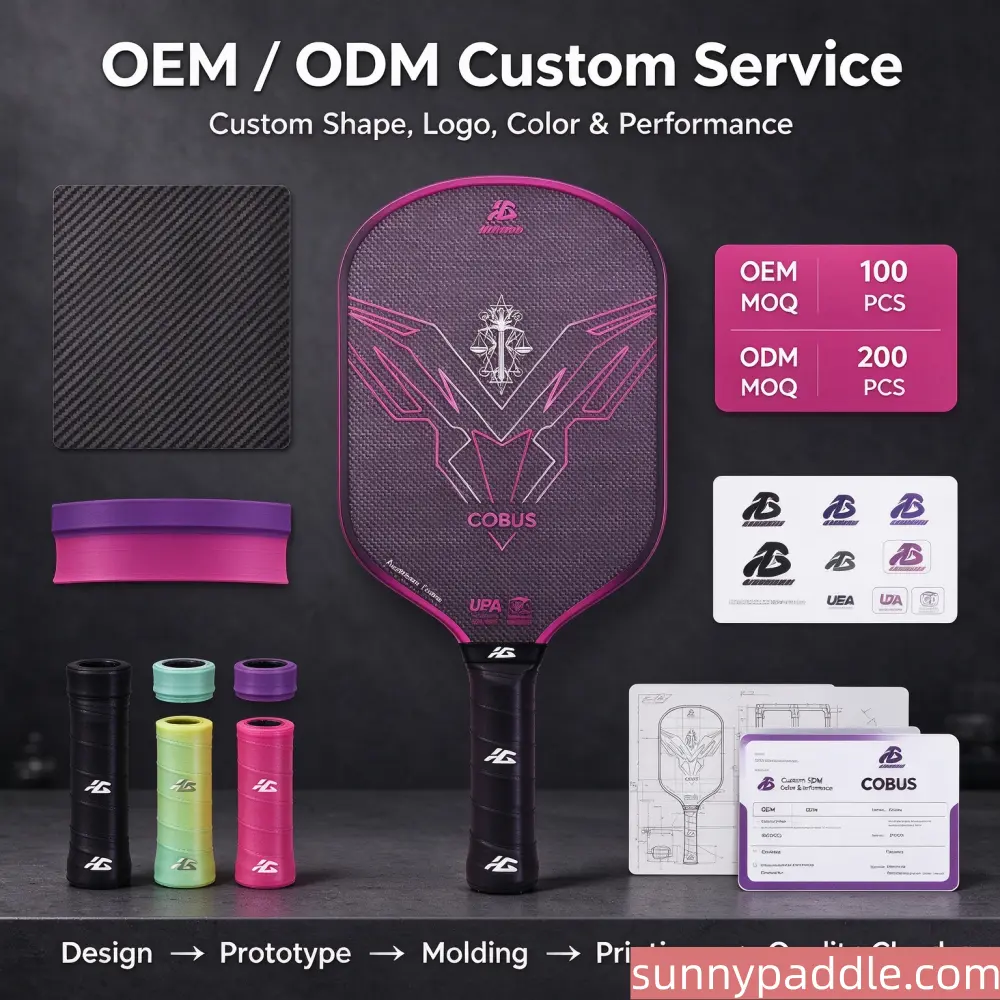
For pickleball paddle projects, Sunny Paddle supports product customization according to customer requirements. Buyers can discuss surface materials, carbon fiber options, product construction, paddle dimensions, graphics, logo printing, and packaging.
Our product development direction includes carbon fiber and fiberglass paddle solutions for different market segments. Customers can explore different material combinations and product configurations according to their technical and commercial objectives.
18.1 Custom Carbon Fiber Pickleball Paddles
Carbon fiber is an important material option for brands developing premium pickleball paddles.
Sunny Paddle can discuss different carbon fiber product concepts, including surface appearance, composite specifications, paddle dimensions, and overall product configuration.
For customers with specific material requirements, the agreed specification should be confirmed during development and sample approval.
18.2 Custom Fiberglass Pickleball Paddles
Fiberglass-based paddle concepts can support brands targeting entry-level and mid-range markets.
Buyers can discuss surface graphics, colors, dimensions, and other customization options according to the selected product design.
18.3 OEM and ODM Private Label Services
Sunny Paddle works with B2B customers seeking private label and custom paddle solutions.
Depending on the product and manufacturing requirements, customization may include surface materials, visual design, brand logos, product specifications, and packaging.
Customers with existing drawings or product samples can provide them for technical review. Buyers who are still developing a new product concept can also discuss potential materials and construction options.
18.4 Sample Development and Production Specification
Sample development is an important step before mass production. It allows the buyer to review the product's actual construction and confirm the required specifications.
For projects involving specialized surface technology, buyers should evaluate surface appearance, texture, material consistency, dimensions, weight, and general product quality.
Once the sample and specifications are approved, they can be used as references for production planning and quality control.
19. Developing Your Next Custom Pickleball Paddle
Pickleball paddle surface technology is an important part of modern paddle product development. Raw carbon fiber, fiberglass composites, surface coatings, texture design, and durability requirements all contribute to the final product.
For international sports brands, the most effective approach is to develop surface specifications according to the target market and product positioning. A premium paddle may require a more detailed carbon fiber specification, while an entry-level product may prioritize practical construction and competitive pricing.
Surface texture should always be considered together with the complete paddle design. Weight, balance, core structure, thickness, stiffness, handle dimensions, and edge construction all influence the finished product.
For OEM buyers, a reliable manufacturing process is essential. Material verification, sample approval, surface inspection, bonding quality, and production consistency should all be included in the product development and procurement process.
Sunny Paddle welcomes inquiries from pickleball brands, wholesalers, distributors, and product development teams looking for custom pickleball paddle manufacturing solutions in China.
Whether you are developing a raw carbon fiber paddle, a fiberglass model, or a new private label product collection, our team can discuss material options, product customization, branding, and OEM/ODM cooperation according to your project requirements.
Contact Sunny Paddle to discuss your next custom pickleball paddle project and explore suitable surface materials and manufacturing solutions for your brand.