Thermoformed vs. Cold-Pressed Pickleball Paddles: An OEM Sourcing Guide for Brands
Introduction: The Technology Evolution in Pickleball Paddle Manufacturing
The global pickleball market has experienced an unprecedented shift in equipment engineering over the past three years. What began as a relatively simple manufacturing landscape dominated by traditional cold-pressed sandwich structures has rapidly evolved into a highly sophisticated, technology-driven industry. Today, player expectations are higher than ever. Modern pickleball enthusiastsâranging from ambitious club players to seasoned prosâdemand paddles that deliver exceptional power without sacrificing control, offer an expanded sweet spot, and maintain structural integrity under intense, high-velocity play.
At the epicenter of this market transformation is the rise of Thermoforming (Hot-Pressing) technology, often referred to in the industry as Generation 2 and Generation 3 paddle construction. While traditional Cold-Pressed manufacturing laid the groundwork for the modern paddle industry and remains a cost-effective choice for entry-level markets, thermoforming has redefined the benchmark for elite-performance paddles.
For sports brands, Amazon sellers, equipment distributors, and private-label startups looking to launch or expand a pickleball product line in 2026, understanding the deep technical and economic differences between thermoformed and cold-pressed paddles is essential. Making the wrong manufacturing choice can lead to misaligned product positioning, inflated warranty claim rates due to core delamination, or lost market share to more technologically advanced competitors.
This comprehensive OEM/ODM sourcing guide breaks down the precise engineering workflows, performance trade-offs, cost structures, quality control challenges, and strategic product-line recommendations to help your brand make data-driven procurement decisions.
Process Comparison: Step-by-Step Manufacturing Workflows
To evaluate these two manufacturing philosophies effectively, procurement and product development teams must look beyond marketing jargon and analyze the physical production steps inside the factory floor.
1. The Cold-Pressed Manufacturing Workflow (Traditional Gen 1 Construction)
Cold-pressed paddle production is fundamentally a multi-layer lamination process carried out at ambient room temperatures or under low-temperature auxiliary heating. The process relies almost entirely on chemical adhesive bonding rather than structural thermal fusion.
- Layer Assembly (Layup): Factory technicians begin by stacking pre-cut composite sheetsâsuch as fiberglass, standard carbon fiber, or graphiteâonto a pre-formed Polypropylene (PP) honeycomb core. Liquid epoxy resin or pre-applied film adhesive serves as the binding agent between the face sheets and the honeycomb core walls.
- Room-Temperature Clamping: The stacked core and face assemblies are placed into multi-slot mechanical or hydraulic cold presses. Pressure is applied uniformly across the flat surface, and the assemblies remain clamped for 2 to 4 hours while the adhesive cures.
- Curing & Shape Trimming: Once cured, the large flat composite sheets are removed from the presses. A CNC router trims the individual paddle shapes out of the cured slab based on the brand's outline template.
- Edge Guard Attachment: Because cold-pressed paddles consist of open-sided honeycomb edges cut directly by the CNC router, an extruded PVC or TPU plastic edge guard must be manually glued around the perimeter. This edge guard is structural; without it, the face sheets would peel away from the core upon side impacts.
- Handle Wrapping & Finishing: Pallet handle scales are glued onto the exposed neck extension, followed by grip tape application, custom end-cap insertion, and final quality inspection.
2. The Thermoformed Manufacturing Workflow (Gen 2/3 Unibody Construction)
Thermoforming represents a radical departure from traditional assembly. It is an integrated, high-temperature, high-pressure molding process that creates a seamless, unibody composite structure where the paddle face, edges, neck, and handle form a single fused unit.
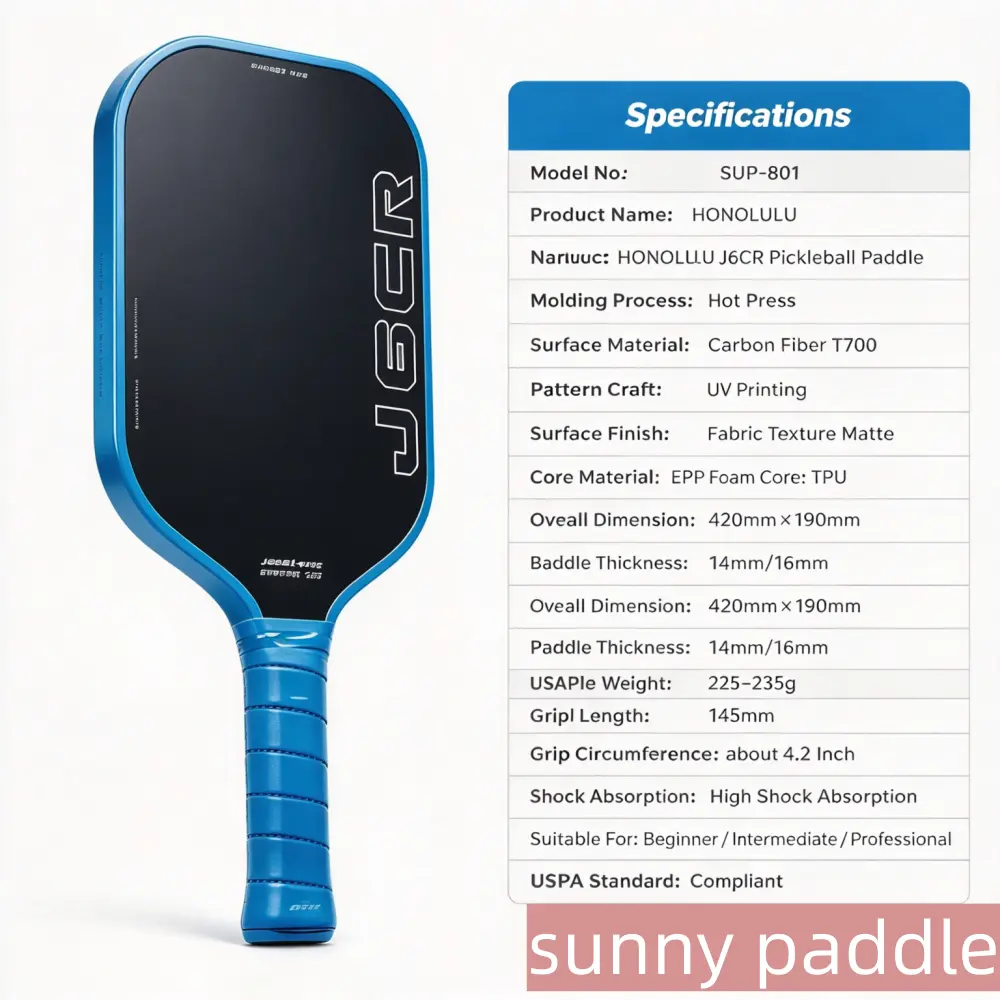
- Unibody Raw Composite Layup: High-grade composite prepregsâmost notably Japanese T700 Raw Carbon Fiber, Kevlar weaves, or hybrid woven fabricsâare layered around a high-density Polypropylene honeycomb core. Crucially, the face materials are not cut flat; they wrap continuously around the perimeter edges and extend all the way down through the handle throat.
- Perimeter Foam Injection (Edge Injection): Prior to molding, a specialized high-density EVA or polyurethane acoustic foam wall is injected or wrapped around the entire outer border of the honeycomb core. This foam perimeter reinforces the vulnerable boundary zone between the core and the outer shell.
- High-Pressure Aluminum Mold Insertion: The assembled unibody blank is placed inside a custom precision-machined CNC aluminum alloy mold. These molds are engineered with intricate internal channels for uniform heat distribution and exact dimensional tolerances.
- Thermoforming Press Cycle (Thermal Fusion): The mold is sealed inside a multi-ton hydraulic hot press. Under exact conditionsâtypically temperatures ranging between 140°C and 165°C under high mechanical pressureâthe epoxy resin within the prepreg melts, flows, and completely saturates the honeycomb cell walls and perimeter foam. The entire assembly undergoes polymer cross-linking, permanently fusing the face, foam, and core into a solid monolithic structure.
- Post-Curing & Precision Trimming: After cooling under pressure, the unibody paddle is ejected from the mold. Excess resin flash is trimmed via precision 5-axis CNC machines. Because the edges are already sealed in fused carbon fiber and foam, the added plastic edge guard serves purely as protective armor against court scraping, rather than a crucial structural glue joint.
Performance Impact: Power, Control, Sweet Spot & Durability
The stark difference in manufacturing workflows translates directly into distinct physical playing characteristics on the court. Understanding these performance metrics allows brand managers to accurately target specific player demographics.
1. Power & Energy Return (Pop)
Thermoformed Paddles: Thermoforming produces a significantly stiffer, perimeter-weighted outer shell. The high-pressure thermal fusion eliminates micro-gaps between the composite face and the honeycomb core. When a pickleball impacts a thermoformed paddle, minimal energy is dissipated through flexing or dampening layers. Instead, the stiff unibody structure acts like a trampoline with high coefficient of restitution (COR), generating immense pop, serve velocity, and baseline driving power.
Cold-Pressed Paddles: Because cold-pressed paddles rely on room-temperature adhesive layers that retain slight viscoelastic flexibility, they absorb a greater portion of the ball's kinetic energy upon impact. This results in noticeably lower ball speed off the paddle face, requiring the player to generate more physical swing effort to achieve deep baseline depth.
2. Control, Dinking & Touch
Cold-Pressed Paddles: What cold-pressed paddles lack in raw power, they historically make up for in soft touch and control. The dampening effect of the cured epoxy glue layer creates a longer dwell time (the fraction of a second the ball stays in contact with the paddle face). This extended dwell time gives intermediate players a greater sense of touch for subtle dinks, third-shot drops, and reset volleys at the kitchen line.
Thermoformed Paddles: Early Gen 2 thermoformed paddles were criticized for being "too hot" or overly poppy, making delicate kitchen play challenging for non-advanced players. However, modern Gen 3 thermoforming techniquesâwhich utilize micro-foam tuning and modified core densitiesâhave bridged this gap. Modern raw carbon fiber thermoformed paddles offer immense spin capability (exceeding 2,000+ RPM) that allows players to bite the ball and shape aggressive drop shots despite the higher inherent power.
3. Sweet Spot Expansion & Twist Weight (Torsional Stability)
Thermoformed Paddles: The inclusion of perimeter foam injection combined with carbon-wrapped edges dramatically alters the Moment of Inertia (MOI). By redistributing structural mass to the outer edges of the paddle head, thermoforming significantly elevates the paddle's Twist Weight. Off-center hits near the 3 o'clock and 9 o'clock edge guards suffer minimal twist, dramatically expanding the usable sweet spot and reducing mis-hits during fast-paced hand battles.
Cold-Pressed Paddles: Standard cold-pressed paddles possess a much lower Twist Weight. Impacts occurring outside the central sweet spot cause the paddle head to twist in the player's hand, leading to dead spots, fluttering ball trajectories, and a noticeable loss of power along the outer edges.
4. Structural Durability & Handle Integrity
Thermoformed Paddles: Because the raw carbon fiber extends continuously from the paddle head down into the butt cap, thermoformed paddles feature a true unibody construction. Handle snapâa frequent point of failure in cold-pressed paddles where the neck joins the handle scalesâis virtually eliminated.
Cold-Pressed Paddles: Cold-pressed paddles utilize a two-piece architecture where the handle consists of wooden or plastic pallet scales glued onto a narrow composite neck extension. Under continuous high-impact play or accidental court scraping, these glued handle joints are prone to loosening, rattling, or snapping cleanly at the throat.
Cost & Defect Rate Analysis: Financial and Engineering Trade-Offs
For B2B buyers, product selection is never purely about performance; it is equally about manufacturing economics, yield rates, and warranty risk management.
1. Cost Breakdown Comparison
The manufacturing cost structure of a thermoformed paddle is substantially higher than that of a cold-pressed paddle due to four main factors: raw material quality, tooling investments, energy consumption, and labor expertise.
- Raw Material Costs: Cold-pressed paddles typically utilize standard fiberglass or basic 3K carbon fiber sheets paired with commercial-grade epoxy resins. Thermoformed paddles demand high-tensile prepreg materialsâsuch as Toray T700 raw carbon fiber or Kevlar hybridsâalongside specialized perimeter EVA foam strips and high-temperature structural resins, driving raw material costs up by 100% to 150%.
- Tooling & Mold Amortization: Cold-pressed paddles are cut from flat slabs using software-driven CNC routers, requiring zero custom molding costs for standard shapes. In contrast, every distinct thermoformed paddle shape, neck length, or thickness profile requires a dedicated CNC-machined steel or aluminum mold set. These high-precision molds represent a significant upfront tooling investment.
- Cycle Time & Energy Intensity: Cold-pressed clamping racks can hold dozens of paddle slabs simultaneously with zero thermal energy input. Thermoforming hydraulic presses require continuous electric heating and precise cooling cycles, producing only a fraction of the hourly unit output per press station compared to cold pressing.
2. The Core Technical Challenge: Core-Crushing and Delamination Control
While thermoforming offers superior performance, it introduces complex manufacturing failure modes that require advanced engineering controls. Chief among these are delamination and core-crushing.
What is Delamination?
Delamination occurs when the face sheet separates from the polypropylene honeycomb core. In a thermoformed paddle, if the molding temperature is too high, the resin cures too quickly before fully wetting the core walls. Conversely, if the pressure is insufficient, the bond fails under repeated impacts. A delaminated paddle creates an illegal trampoline effect, resulting in uncontrolled power and eventual product failure.
What is Core-Crushing?
During the thermoforming process, the honeycomb core is subjected to extreme heat and multi-ton hydraulic pressure. If the core material quality is inconsistent or if the press pressure exceeds the compressive strength threshold of the PP cells, the internal honeycomb walls collapse inward. This creates permanent "dead spots" where the paddle face feels soft and hollow.
How Advanced Factories Solve Delamination & Core Crushing
To eliminate these defects, premier OEM manufacturers implement three critical technical controls:
- Precision Pressure & Temperature Profiling: Utilizing automated multi-stage press cycles where temperature and pressure are modulated in real time using internal mold sensors.
- Proprietary Resin Formulations: Toughened epoxy resins blended with nano-rubber additives that maintain elastic flexibility after heat curing, absorbing shear stresses between the rigid carbon face and flexible PP core.
- Automated 100% Acoustic & Deflection Testing: Scanning 100% of finished paddles with frequency-response acoustic sensors and digital deflection gauges to detect micro-delaminations before paddles leave the factory floor.
Which Should Your Brand Choose? Strategic Product Line Matrix
A successful sports brand rarely relies on a single manufacturing technology. Instead, market leaders build structured product portfolios that match specific price points and player personas to the correct manufacturing process.
Product Line Segmentation Matrix
To optimize your inventory investment and maximize retail margins, consider the following strategic allocation:
- Entry-Level / Recreational Series (Target MSRP: $30 – $60)
- Recommended Process: Cold-Pressed Construction.
- Face Material: Fiberglass or Standard 3K Carbon Fiber.
- Core Thickness: 13mm to 16mm Standard PP Honeycomb.
- Target Buyer: Beginners, casual family players, school programs, and resort rental sets.
- Strategic Rationale: Keeps FOB costs ultra-competitive while offering vibrant UV-printed graphics, light weight, and forgiving control.
- Mid-Tier / Performance Growth Series (Target MSRP: $70 – $120)
- Recommended Process: Advanced Cold-Pressed or Hybrid Semi-Thermoformed Construction.
- Face Material: T700 Raw Carbon Fiber or Textured Graphite.
- Core Thickness: 14mm to 16mm PP Core with Edge Perimeter Reinforcement.
- Target Buyer: Intermediate club players (3.0 to 4.0 USAPA skill levels) seeking enhanced spin and consistency without paying premium tour prices.
- Strategic Rationale: Delivers modern raw carbon spin performance and durability at an accessible price point, maximizing sales volume on channels like Amazon.
- Flagship / Elite Tournament Series (Target MSRP: $130 – $220+)
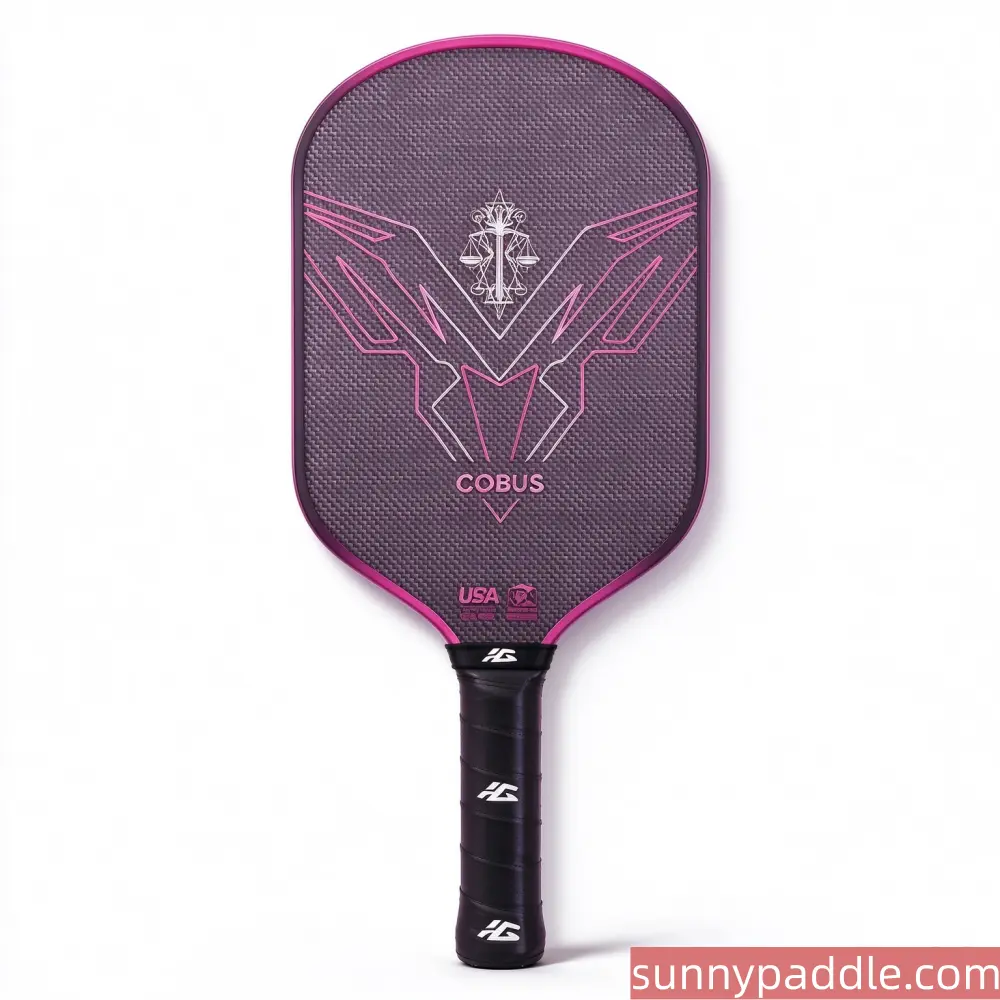
- Recommended Process: Full Unibody Thermoforming with Edge Foam Injection (Gen 2/3).
- Face Material: Premium Japanese Toray T700 Raw Carbon Fiber, Kevlar Hybrid, or Titanium Composite.
- Core Thickness: 13mm (Power), 14mm (All-Around), or 16mm (Control).
- Target Buyer: Advanced competitive players (4.5+ level), tournament players, and brand ambassadors.
- Strategic Rationale: Establishes your brand's technological credibility. Features maximum spin rates (2000+ RPM), high twist weight, unibody handle strength, and full USAP certification compliance.
Why Sunny Paddle is Your Premier OEM/ODM Manufacturing Partner
Navigating the transition from traditional cold pressing to advanced thermoforming requires an OEM manufacturing partner with deep composite engineering expertise, reliable supply chains, and uncompromising quality control standards. This is precisely where Sunny Paddle excels.
As a leading direct-factory manufacturer specializing in high-performance racket sports equipmentâincluding pickleball paddles, padel rackets, and beach tennis racketsâSunny Paddle serves as the manufacturing engine behind top-tier sports brands worldwide.
The Sunny Paddle Manufacturing Advantage
- State-of-the-Art Thermoforming Infrastructure: Our production facility is equipped with automated high-precision hydraulic hot presses, climate-controlled clean rooms for prepreg layup, and multi-axis CNC trimming machinery. We have mastered resin-flow dynamics to guarantee zero core-crushing and industry-leading delamination prevention.
- Premium Global Materials: We partner directly with top-tier raw material suppliers to source authentic Japanese Toray T700 raw carbon fiber, high-grade Kevlar weaves, and high-density PP honeycomb cores, ensuring your paddles achieve superior spin rates and structural longevity.
- Rigorous In-House Quality Assurance: Every paddle manufactured by Sunny Paddle undergoes stringent multi-stage inspection. Our laboratory conducts pull-strength testing, ball-impact fatigue cycles (100,000+ impacts), deflection testing, and 100% weight-tolerance checks (maintaining a tight ±3g variance).
- Comprehensive USAP Certification Support: We pre-test all custom prototypes in our facility using USAP-compliant deflection and surface roughness measuring equipment, giving your custom designs a 99%+ first-time pass rate at official USAP testing labs.
- Turnkey Private Label & Custom Molding Services: From low-MOQ trial orders for growing brands to full custom mold development (3D CAD design, prototyping, and exclusive tooling protection under strict NNN agreements), we offer a seamless one-stop solution including custom edge guards, grips, neoprene covers, and FBA-ready packaging.
Conclusion & Call to Action: Request Your Dual-Technology Sample Kit
Choosing between thermoformed and cold-pressed paddles doesn't have to be a blind decision. The best way to evaluate the tangible differences in weight distribution, surface texture, power output, and craftsmanship is to test them firsthand in your own testing facilities or on the court.
Sunny Paddle invites sports brand executives, product managers, and procurement teams to request our exclusive OEM Dual-Technology Sample Kit.
Our sample kit includes side-by-side comparison models featuring both high-precision Cold-Pressed and state-of-the-art Unibody Thermoformed paddles, fully customized with T700 Raw Carbon faces and perimeter foam technology.
Contact the Sunny Paddle Engineering & Sales Team today to request your sample kit, discuss custom mold development, or receive an immediate OEM factory quotation for your upcoming product line!